MRC and Dialogue Partners mark 30 years of cooperation on the Mekong River Basin
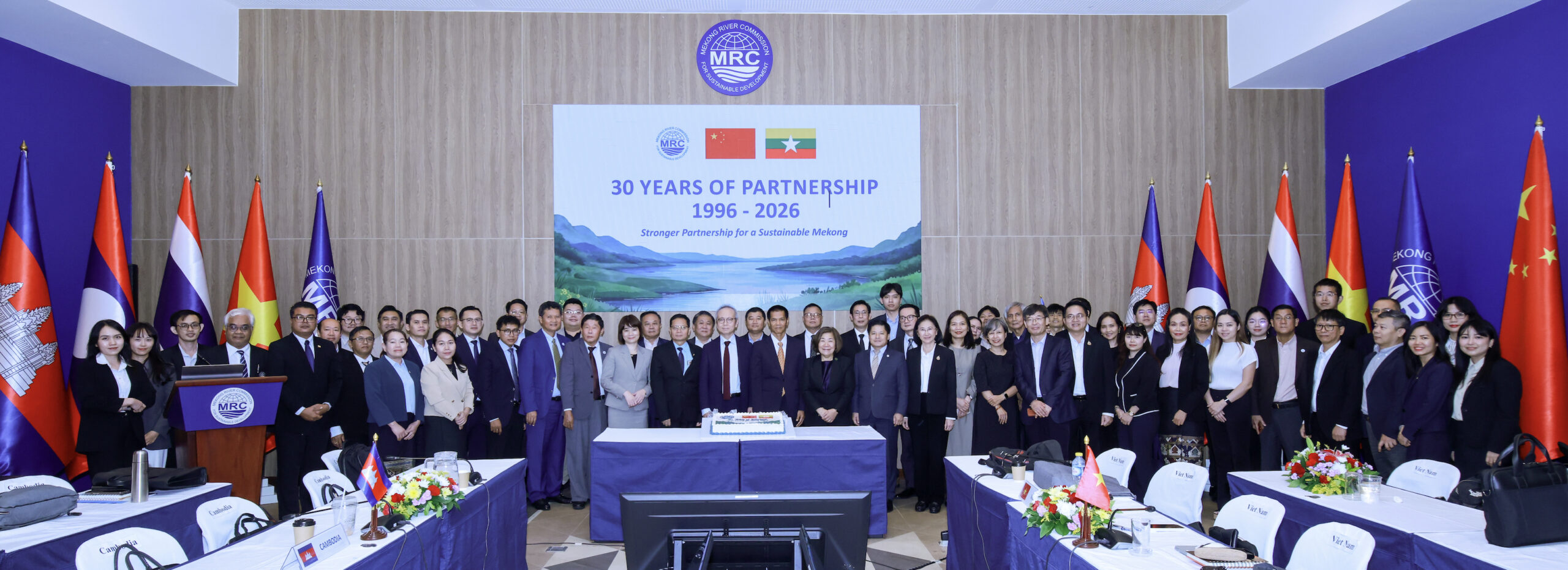
Vientiane, Lao PDR, 18 September 2026 – The Mekong River Commission and its Dialogue Partners, China and Myanmar, celebrated the 30th anniversary of the establishment of their formal dialogue. The four Member Countries of the Lower Mekong Basin met with China and Myanmar to review their longstanding cooperation and set practical steps to strengthen cooperation across the entire Mekong Lancang River Basin. The 30th Dialogue Partners Meeting was held at the MRC Secretariat in Vientiane as changing rainfall, flood and drought risks, water quality concerns and shifting river flows increase the need for timely information exchange and coordinated action.
The first dialogue meeting was held in Bangkok on 26 July 1996. Since then, the dialogue has taken place and provided the six countries with the opportunity to exchange information and update forecasting and monitoring, water conditions and release, as well as discuss shared concerns and identify areas to strengthen cooperation. The meeting focussed on hydrological data, joint modelling, environmental monitoring and future basin planning.
“30 years ago, all the riparian countries agreed to exchange information on activities and projects concerning the use of the Mekong River and its resources, to seek ways and means to cooperate in the use of the Mekong River and its resources for different purposes and in a sustainable manner, and to strive for development in the six riparian countries for the benefit of the people,” H.E. Mr So Sophort, Secretary General of the Cambodia National Mekong Committee and the Chairperson of the MRC Joint Committee for 2026, stated.
He emphasised that this cooperation has become increasingly important, particularly when the Mekong-Lancang River Basin faces growing environmental and socio-economic challenges, including the escalating impacts of climate change and weather variability.
China has shared hydrological information from Yunjinghong and Manan stations for 24 consecutive years, with year-round data provided since November 2020. Mr Xu Jinsong, Counsellor of the Embassy of China in Thailand said in his statement that, “The six countries have agreed in principle under a Memorandum of Understanding on the mutual provision of hydrological information for the Lancang Mekong River Basin.”
He added that, “The six countries should achieve the goal of sharing full information on the Lancang Mekong River Basin as early as possible, which will help strengthen upstream and downstream coordination to address the challenges of flood and drought disasters together.” Future cooperation proposed by China includes urgent notifications, wider basin data sharing, and joint work on flood forecasting and drought response.
The meeting also reviewed Phase 2 of the Joint Study on changing hydrological conditions and adaptation strategies. The work brings together the MRC, the Lancang Mekong Water Resources Cooperation Center, Myanmar and technical teams from all six countries. The updated analysis uses 22 Global Climate Models, three climate scenarios and linked models for the Mekong mainstream, Tonle Sap system and Mekong Delta. Regional and national consultations are planned for October, followed by the Joint LMC-MRC Expert Group Meeting on Data, Modelling and Forecasting in November before submission of the final technical report for endorsement.
The meeting also reviewed and received updates on regional cooperation following the detection of arsenic contamination in the Kok, Sai and Ruak Rivers in northern Thailand and its confluences with the Mekong in 2025. The routine water quality monitoring at 15 Mekong mainstream stations found that most results from January to June 2026 remained within MRC guideline values for the protection of human health and aquatic life. The meeting highlighted the importance of continued water quality monitoring, strengthening information sharing, as well as technical exchange and cooperation.
At the meeting, Myanmar presented its national progress in water resources and water quality management, including the adoption of its National Surface Water Quality Standard in 2024. Current initiatives include a national flood and drought portal, automatic water level and rainfall monitoring in border areas, assessment of toxic contaminants and water quality monitoring in the Mekong River and its branches in Shan State. Myanmar identified water quality assessment, comprehensive monitoring systems, technology transfer, research and human resource development as priority areas for further regional cooperation.
“We firmly believe that deepening cooperation with the MRC will strengthen our joint efforts for the sustainability, development, and systematic management of water resources for the benefit of all people in the Mekong region. We must continue to work together to protect our shared water resources,” Mr Aung Kyaw Moe, Deputy Director General of the Myanmar’s Environmental Conservation Department.
Countries were also updated on Proactive Regional Planning, which focused on integrating water, food and energy needs into one basin assessment. The upgraded MRC Decision Support Framework is now operational and is being used to update development scenarios and the Initial Adaptive Basin Plan. National consultations and expert review will continue before the plan is finalised in early December 2026.
The discussions highlighted the value of regular exchange among all six countries and placed the next stage of cooperation on practical delivery with more timely data, stronger joint analysis and faster coordination when conditions change anywhere along the river.
“Trust in river cooperation is built through consistent action, such as sharing data as agreed, communicating changes in a timely manner, with a view for better preparedness and protection of the Mekong and its peoples. Let us carry this cooperation forward with openness and a shared purpose, so the Mekong continues to sustain communities and connect our countries for generations to come,” said Ms Busadee Santipitaks, Chief Executive Officer of the MRC Secretariat.
About the Mekong River Commission and its Dialogue Partners
The MRC is an intergovernmental organisation established in 1995 to boost regional dialogue and cooperation in the Lower Mekong River Basin. Based on the Mekong Agreement among Cambodia, Lao PDR, Thailand, and Viet Nam, the MRC serves as both a regional platform for water diplomacy and a knowledge hub to manage water resources and support sustainable development of the region.
China and Myanmar have been Dialogue Partners of the MRC since 1996. Through annual Dialogue Meetings, high level participation, technical exchanges and joint studies, the partnership supports cooperation and information sharing among all six Mekong countries. Cooperation with China also includes year round hydrological data sharing from two Upper Mekong stations to strengthen river monitoring and flood and drought forecasting.
Photos can be downloaded here: https://drive.google.com/drive/folders/1Sfeqzrheoisxb3k_-HBj_Bj3OpCCyj8R?usp=sharing
-END-
For more information, please contact:
Chandaly Mao (Ms.)
Communications Officer for Press
Mekong River Commission Secretariat
Email: chandaly@mrcmekong.org