MEKONG RIVER COMMISSION

STRATEGIC PLAN 2026-2030

Purpose and scope of the Strategic Plan

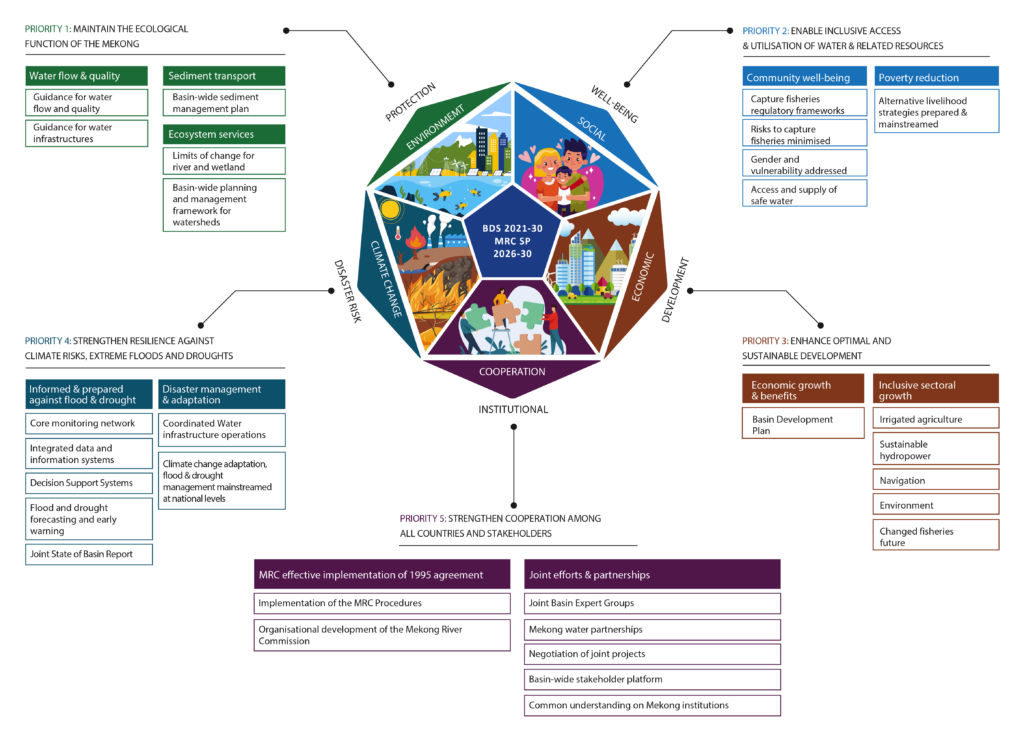
This Mekong River Commission Strategic Plan (MRC SP) for 2026-2030 is a unified corporate plan that is fully integrated with the Basin Development Strategy (BDS) 2021-2030 through the implementation of the strategic basin planning cycle

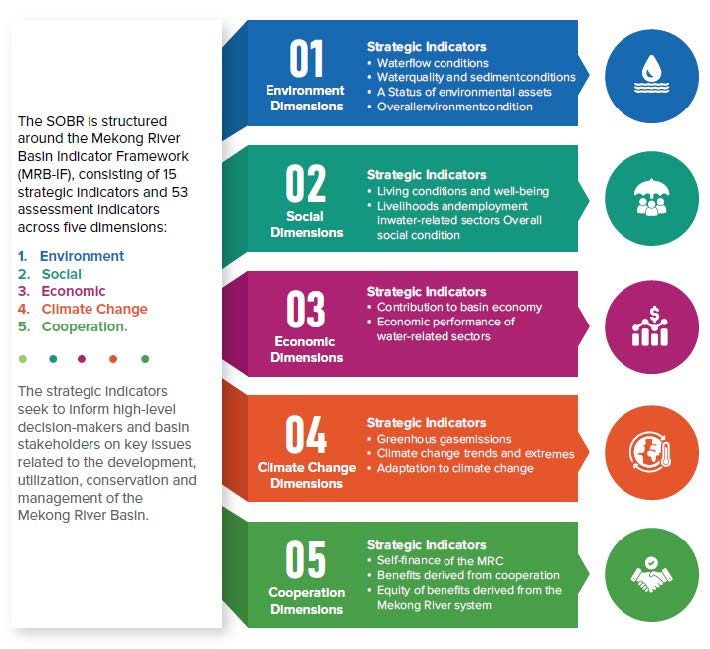
Mekong River Basin Indicator Framework (MRB-IF)​

A key characteristic of the cycle is the linkage between the five-yearly State of the Basin Reports (SOBR) and the ten-yearly BDS, with the former recording and evaluating the development and management impacts (positive and negative) within the Mekong River Basin, and the latter aimed at the improvement of the conditions in the basin in the 5 dimensions of the Mekong River Basin Indicator Framework (MRB-IF): environment, social, economic, climate change, and cooperation. This MRC SP sets out how the MRC will continue to contribute to the implementation of the BDS and strengthen the organization over the next five years in preparation for its post 2030 role.

Foundations of the MRC Strategic Plan

The foundations of the MRC SP 2026-2030 are.

1995 Mekong Agreement

MRC Summits

Basin Development Strategy 2021-2030

2023 Mekong State of the Basin Report

Focus Areas of the MRC SP 2026-2030

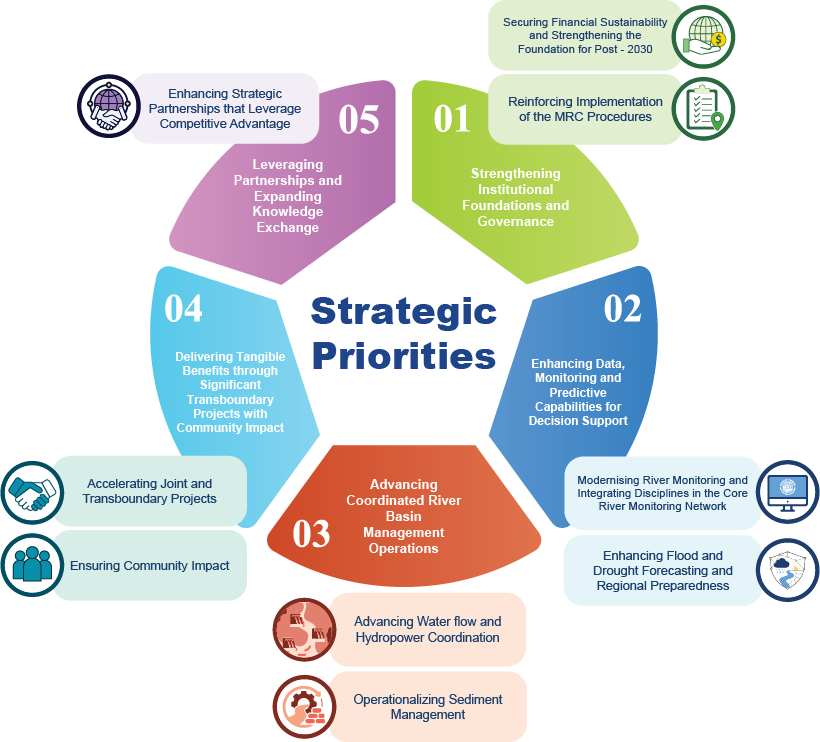
The MRC is committed to the effective implementation of the 1995 Mekong Agreement, and its role as the primary regional water cooperation and diplomacy platform and knowledge hub to enhance the implementation of basin-wide strategies, procedures, guidelines, and data and information sharing that drives peaceful and mutually beneficial cooperation to achieve our shared vision for an economically prosperous, socially just, environmentally sound and climate resilient Mekong River Basin. Building on the achievements from the MRC SP 2021-2025, the MRC SP 2026-2030 emphasises:

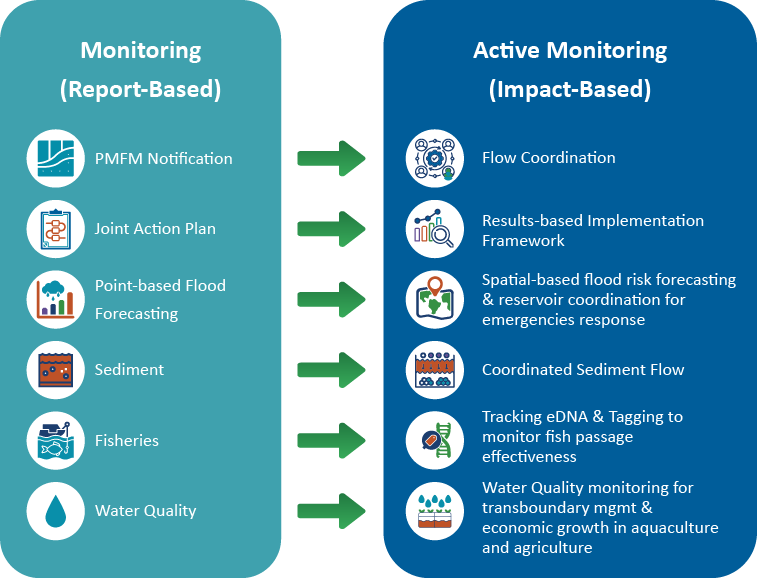
Across the five focal areas, the MRC will implement a strategic shift to impact focused monitoring to improve mutual accountability at regional and national levels for achieving positive impacts for basin communities. This includes utilising the MRC Procedures in support of more active flow coordination, instituting a results-based implementation framework for agreed measures in the Joint Action Plans, and implementing spatially relevant risk forecasting and more targeted monitoring activities linking current conditions to planning and management decisions that all parties can work together to address.

1. Strengthening Institutional Foundations and Governance

The MRC will strengthen the core institutional elements necessary for its effectiveness, sustainability, and ability to govern. This includes an emphasis on financial sustainability, institutional capacity and authority and reinforcing implementation of the MRC Procedures.

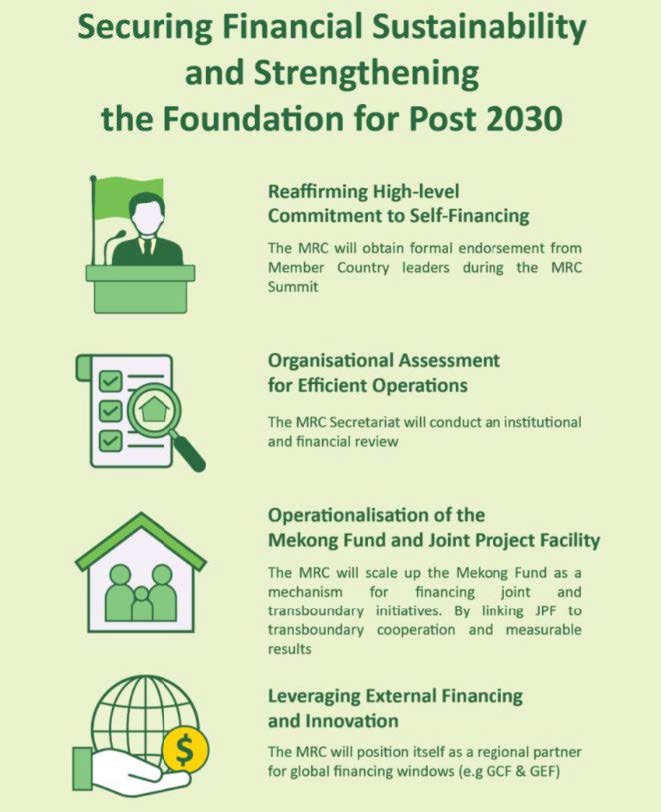
Securing Financial Sustainability and Strengthening the Foundation for Post 2030

The MRC is advancing toward a self-financing model based on predictable and equitable Member Country contributions. Strengthening financial independence aims to solidify regional ownership and ensure greater accountability, reinforcing the Commission’s role as a resilient, trusted, and self-sustaining regional institution.

Strategic Approach

To establish a resilient and self-sustained Mekong River Commission beyond 2030, the MRC will implement a financial sustainability strategy anchored in Member Country ownership, diversified funding, institutional efficiency, and results-driven accountability. This strategy will be structured around 4 interlinked actions:

Key Deliverables:

  • MRC Summits (2027; 2030) (Output 5.1.2)
  • Joint Projects Facility with joint and transboundary investment projects delivered (2028) (Output 4.2.2)
  • Final Mekong Fund operating arrangements (2030) (Output 5.1.2)
  • Mekong Fund Trial to support wetland and watershed management (2030) (Output 1.3.1)
  • Roadmap for post-2030 financing, with targets, funding modalities and aligned staffing levels (2028) (Output 5.1.2)
  • Accreditation of MRC to global climate funds (2028) (Output 4.2.2)

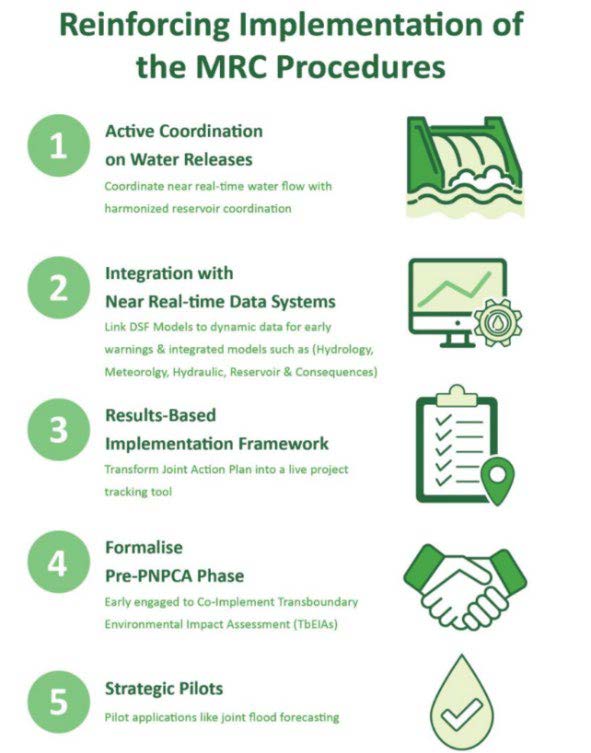
Reinforcing implementation of the MRC Procedures

The MRC Procedures—the PNPCA, PDIES, PWUM, PMFM and PWQ—are the pillars of effective Mekong governance. The MRC will strengthen implementation, compliance, and institutional capacity to uphold these rules as the foundation for building trust, equity, and intensifying cooperation including through a more proactive approach.

Strategic Approach

The MRC will move beyond monitoring and notification to proactive management of the whole river network by making better and more immediate use of data and information collected to support decision-making. Near real-time updates to data and information will be pursued through communication and data analytics platforms that provide information to decision-makers as and when needed to ensure increased effectiveness and value-add on the MRC’s significant data resources. Implementation of the MRC Procedures will be strengthened through the following key actions:

Key Deliverables:

  • Overview of the hydrology of the entire Mekong-Lancang River Basin (2027) (Output 1.1.1)
  • Finalised hydrological thresholds for PMFM guidelines and flow framework (2028) (Output 1.1.1)
  • Updated Technical Guideline for PWUM (2028) (Output 1.1.1)
  • Notifications and management actions in accordance with MRC Procedures (annual) (Output 1.1.1)
  • Updated TGWQ, thresholds, and scoring methodologies (2028) (Output 1.1.1)
  • Mainstreaming of TbEIA guidelines into national EIA systems and regulations as needed and project-specific assessment reports (annual) (Output 1.1.2)
  • Implementation of the PNPCA and updated Guidelines for sustainable water infrastructure development (annual) (Output 5.1.1)
  • Key priorities for selected tributaries of basin-wide significance agreed and implemented (2029) (Output 5.1.1

The MRC is working with Member Countries to deliver tangible on-the-ground actions and engagement to ensure that regional cooperation translates into measurable benefits for stakeholders, especially local communities.

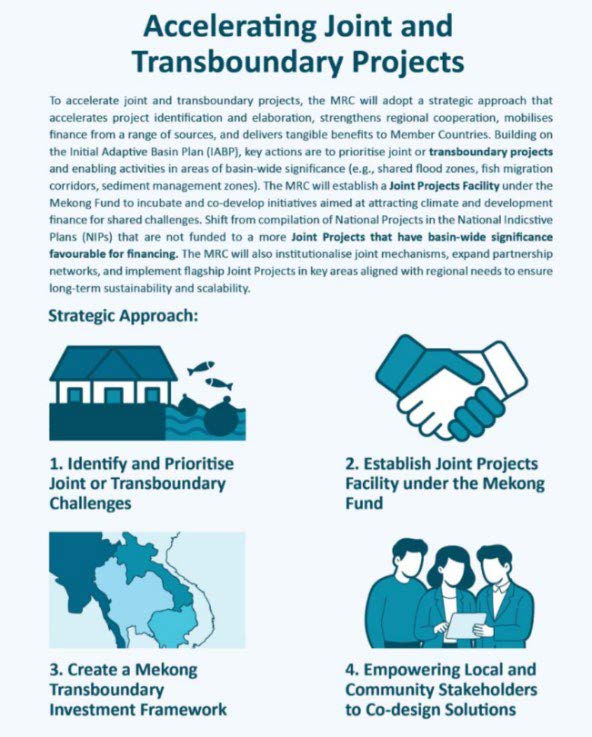
Accelerating Joint and Transboundary Projects

MRC will expand its role as a platform for cooperative action by accelerating joint and transboundary initiatives. It will scale-up its portfolio of joint and transboundary projects to address shared challenges such as flood and drought management, fisheries decline, the energy transition and increasing transboundary water quality concerns. These initiatives will promote collaboration, optimize resourcing, and deliver concrete benefits across Member Countries at the national and local levels.

Strategic Approach

Key Deliverables

  • Reports on Joint water quality monitoring including status of heavy metals in the Mekong Basin (2028) (Output 1.1.1)
  • Mekong Fund Trial to support wetland and watershed management (2030) (Output 1.3.1)
  • Scaled-up wetland and watershed management pilot projects (2030) (Output 1.3.2)
  • Adaptive fisheries management mechanisms established for Transboundary Fisheries Conservation in the Mekong Basin (2028) (Output 2.1.3)
  • Final Adaptive Basin Plan including agreed pathways for joint projects and enabling activities (2027) (Output 3.1.1)
  • Joint Projects Facility with joint and transboundary investment projects delivered (2028) (Output 4.2.2)

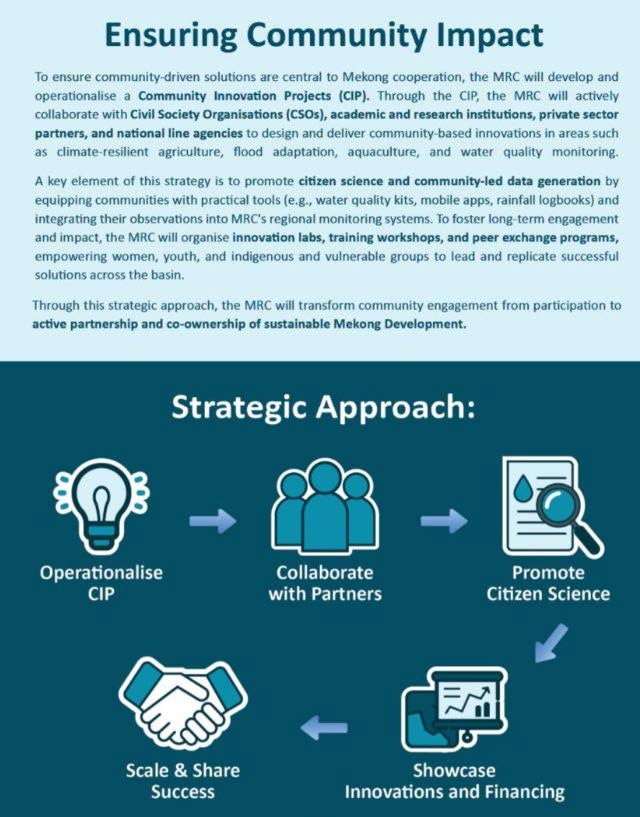
Ensuring Community Impact

Communities across the Mekong River Basin face growing challenges from climate change, environmental degradation, and increasing demand for shared water resources. While the MRC has made progress in regional policy and basin planning, there remains a need to translate these efforts into tangible outcomes at the local level. Strengthening community engagement and demonstrating the practical benefits of regional cooperation are critical to building trust and resilience. Joint pilot projects offer a strategic approach for innovative solutions, promote knowledge exchange, and scale successful models across borders. These initiatives serve as a bridge between policy and practice, reinforcing the MRC’s relevance and visibility at the grassroots level.

Strategic Approach

Key Deliverables

  • Reports on Joint water quality monitoring including status of heavy metals in the Mekong Basin (2028) (Output 1.1.1)
  • Mekong Fund Trial to support wetland and watershed management (2030) (Output 1.3.1)
  • Scaled-up wetland and watershed management pilot projects (2030) (Output 1.3.2)
  • Adaptive fisheries management mechanisms established for Transboundary Fisheries Conservation in the Mekong Basin (2028) (Output 2.1.3)
  • Final Adaptive Basin Plan including agreed pathways for joint projects and enabling activities (2027) (Output 3.1.1)
  • Joint Projects Facility with joint and transboundary investment projects delivered (2028) (Output 4.2.2)

Advancing Coordinated River Basin Management Operations

While the MRC has made significant strides in basin planning and monitoring, there is an urgent need to enhance real-time flow coordination, flood and drought risk management, and environmental flow regulation through regional cooperation. The MRC will work with Member Countries and infrastructure operators on coordinated flow management to support transboundary resilience, protect ecosystems, and ensure equitable and sustainable water use.

Advancing Water Flow and Hydropower Coordination for Multiple Benefits

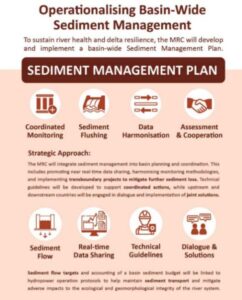
To sustain river health and delta resilience, the MRC will develop and implement a basin-wide Sediment Management Plan. The plan will enable coordinated and joint sediment monitoring, sediment flushing, data harmonization, assessment and cooperation with hydropower operators to mitigate sediment trapping and preserve ecological functions.

Strategic Approach

Key Deliverables

  • Water quality, sediment, and salinity integrated into MRC-DSF (2030) (Output 4.1.3)
  • Increased data and information sharing from dam operators (2027) (Output 4.2.1)
  • Guidelines for hydropower flow and reservoir coordination, supported by a hydropower flow coordination system (2029) (Output 4.2.1)
  • An active coordination mechanism for water releases in water-related disaster management (2030) (Output 4.2.1)

Operationalizing Basin-wide Sediment Management

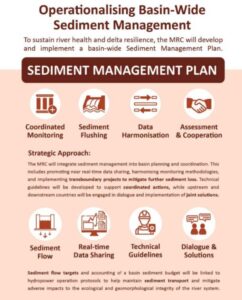
To sustain river health and delta resilience, the MRC will develop and implement a basin-wide Sediment Management Plan. The plan will enable coordinated and joint sediment monitoring, sediment flushing, data harmonization, assessment and cooperation with hydropower operators to mitigate sediment trapping and preserve ecological functions.

Strategic Approach

Key Deliverables

  • Basin-wide sediment budget assessment (2026) (Output 1.2.1)
  • Basin-wide sediment management plan (2027) (Output 1.2.1)
  • Water quality, sediment, and salinity integrated into DSF (2030) (Output 4.1.3)
  • Implementation of coordinated sediment flushing (2030) (Output 1.2.1)

The MRC is working with Member Countries to deliver tangible on-the-ground actions and engagement to ensure that regional cooperation translates into measurable benefits for stakeholders, especially local communities.

Accelerating Joint and Transboundary Projects

MRC will expand its role as a platform for cooperative action by accelerating joint and transboundary initiatives. It will scale-up its portfolio of joint and transboundary projects to address shared challenges such as flood and drought management, fisheries decline, the energy transition and increasing transboundary water quality concerns. These initiatives will promote collaboration, optimize resourcing, and deliver concrete benefits across Member Countries at the national and local levels.

Strategic Approach

Key Deliverables

  • Reports on Joint water quality monitoring including status of heavy metals in the Mekong Basin (2028) (Output 1.1.1)
  • Mekong Fund Trial to support wetland and watershed management (2030) (Output 1.3.1)
  • Scaled-up wetland and watershed management pilot projects (2030) (Output 1.3.2)
  • Adaptive fisheries management mechanisms established for Transboundary Fisheries Conservation in the Mekong Basin (2028) (Output 2.1.3)
  • Final Adaptive Basin Plan including agreed pathways for joint projects and enabling activities (2027) (Output 3.1.1)
  • Joint Projects Facility with joint and transboundary investment projects delivered (2028) (Output 4.2.2)

Key Deliverables

  • Reports on Joint water quality monitoring including status of heavy metals in the Mekong Basin (2028) (Output 1.1.1)
  • Mekong Fund Trial to support wetland and watershed management (2030) (Output 1.3.1)
  • Scaled-up wetland and watershed management pilot projects (2030) (Output 1.3.2)
  • Adaptive fisheries management mechanisms established for Transboundary Fisheries Conservation in the Mekong Basin (2028) (Output 2.1.3)
  • Final Adaptive Basin Plan including agreed pathways for joint projects and enabling activities (2027) (Output 3.1.1)
  • Joint Projects Facility with joint and transboundary investment projects delivered (2028) (Output 4.2.2)

The MRC is working with partners within the region and globally to raise the profile of the MRC, import new and innovative river management knowledge, tools and expertise, and leverage the skills and capacities of partner organisations in areas of competitive advantage.

Enhancing Strategic Partnerships that leverage competitive advantage

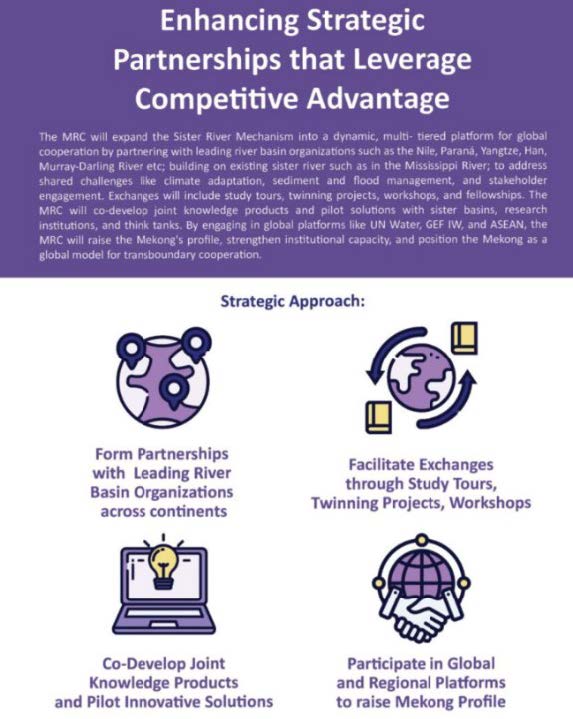
Global cooperation and concerted efforts are essential in a fast-paced competitive and changing international environment. The MRC will deepen cooperation with international river basins through its Sister River Mechanism, fostering fellowships, knowledge exchange and innovation. Through the Sister River Mechanism, the MRC will expand its partnerships with other international river basins to exchange knowledge and best practices, accelerate innovation, and amplify the Mekong voice in the ASEAN and global dialogues.

Strategic Approach

Key Deliverables:

  • Partnership agreements with Development Partners, ASEAN, GMS, MLC Water Center, ACMECS, Mekong-US, Mekong-Australia, Mekong-Japan, and Mekong-ROK implemented (annual) (Output 5.2.3)
  • Sister River Partnerships expanded with river basin organisations and joint work programme agreed (2027) (Output 5.2.3)
  • Implementation of agreed Joint Studies, Data/module sharing (annual) (Output 5.2.4)
  • Enhanced cooperation on water-environment-energy linkages with other regional frameworks (2029) (Output 3.2.2)
  • Basin-wide Alternative Energy Planning Review (2030) (Output 3.2.2)

Strategic Areas

The Mekong River Commission Strategic Plan (MRC SP) 2026–2030 is a unified corporate plan, fully integrated with the Basin Development Strategy (BDS) 2021–2030. It sets out how the MRC will continue contributing to the achievement of the BDS while further strengthening the organisation over the next five years in preparation for its post-2030 role. Reinforcing institutional foundations and asserting regional leadership are considered imperative to ensuring long-term sustainability and resilience.

Building on the achievements of previous Strategic Plans, the MRC SP 2026–2030 places emphasis on the following strategic areas:

Protection

PRIORITY 1: MAINTAIN THE ECOLOGICAL FUNCTION OF THE MEKONG

Well-Being

PRIORITY 2: ENABLE INCLUSIVE ACCESS & UTILISATION OF WATER & RELATED RESOURCES

Test PopUp

© 2024 Mekong River Commission

Dr. An Pich Hatda

Former Chief Executive Officer (CEO) of the Mekong River Commission (MRC) Secretariat 
Hatda

Mr. Pham Tuan Phan

First Riparian Chief Executive Officer (CEO) of the Mekong River Commission (MRC) Secretariat

Mr. Hans Joakim GUTTMAN

Former Chief Executive Officer (CEO) of the Mekong River Commission (MRC) Secretariat 

Mr. Jeremy Douglas BIRD

Former Chief Executive Officer (CEO) of the Mekong River Commission (MRC) Secretariat 

Mr. Kristensen Joern

Former Chief Executive Officer (CEO) of the Mekong River Commission (MRC) Secretariat 

Dr. Olivier Cogels

Former Chief Executive Officer (CEO) of the Mekong River Commission (MRC) Secretariat 

Mr. Yasunobu Matoba

Former Chief Executive Officer (CEO) of the Mekong River Commission (MRC) Secretariat